C-7 Home Page  C-7 News
Consignment
Library
Products & Services
Product Lines
Order
Search C7.com
C-7 News
Consignment
Library
Products & Services
Product Lines
Order
Search C7.com
Leica Index
Binoculars |
||||||||||||||||||||||||||||

|
|
|||||||||||||||||||||||||||
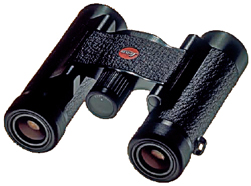
Trinovid and ULTRAVID Compact Series Models:
|
 |
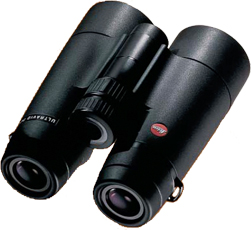
Trinovid and ULTRAVID Mid and Full Size Models:
|
 |
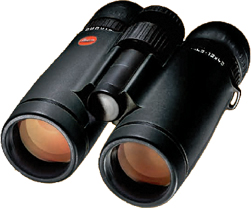
| DUOVID Models: |
 |
GEOVID Range Finding Models:
|
 |
|
GEOVID LUX Range Finding/Data-Voice Transmitting Models:
|
 |
 Overview: What Makes a Leica Binocular Special
The Leica line has since 1907 expanded and developed new technologies to now offer the perfect binocular for virtually every use. Most binoculars are compromises of durability and resistance to the elements, and of balance, weight, size and performance. The decision to buy a Leica binocular is a decision in favor of uncompromising quality. Leica's binoculars provide unsurpassed sharpness, clarity, color fidelity and image definition. You literally have to see to believe: how a distant object can be drawn in to you until it appears close enough to touch, sharp and crystal clear. How easy it is to distinguish the most delicate textures and hues, the smallest details...even in low light, thanks to a brilliance produced by high resolving power and increased definition.
Most of our customers prefer to buy one comparatively compact high performance binocular, even at greater cost than to buy a less costly bulkier and heavier binocular that might only in some ways approach the optical performance of the better smaller binocular. The Leica binocular and spotting telescopes are as close to perfection in all the critical areas as modern technology permits. In fact each Leica may be the last binocular or spotting telescope that you ever buy - though in time you may come back to Company Seven to buy several different models for varying applications. Leica is is so certain of the merits and durability of their product that their confidence is tangibly backed by a most incredible warranty!
Leica owners can enjoy the advantages of optical superiority and structural reliability even under the most demanding conditions:
) |
) |
"I am a professional outfitter and the optics I use are Leica's cause they are toughest and best on the market.
The common obvious differences between the Leica binocular models are magnification and field of view, physical size and weight, and brightness. There are less obvious design considerations including Eye Relief (the distance between the observers eye and an eyepiece), Interpupilary Distance (the separation distance between the observers two eyes, binocular feel and balance in your hands. We urge customers to visit our showroom to try these out to see which one(s) will feel the best in your hands, see if one of them 'talks to you'. Alternatively we can send them to you almost anywhere in the world. Before you try we have some homework below for you, this will help you to better understand the choices as you move forward in selecting a binocular that can provide a lifetime of great service.
Background: How The Eye Works a binocular can be thought of as a light funnel gathering light through its objective (front) lens, with prisms to erect the image, and with an eyepiece funneling light into the eye.
The anterior chamber of the eye is filled with vitreous fluid, a clear jelly-like solution; light passes through the vitreous on it's way through the Lens and to the Retina. After light passes beyond the Pupil it then encounters the Lens, a transparent crystalline biconvex lens also known as the aquula. We can not see the lens of another person without specialized exam equipment, hence it is not illustrated at right. The Lens is supported in place behind the Pupil by small tissues that pull or relax thereby changing the shape of the lens to focus the light onto the Retina at the rear of the eye. The Cornea and the Lens refract the light and focus distant or near objects onto the Retina that lines the inside rear wall of the eyeball. The retina is lined with light-sensitive sensors (cones and rods) that accumulate the visual signal and then transmit the information through the optic nerve to the brain where the signals are processed. And so by dilating and exposing more sensors to the stimulis, then the Iris causes the eye to compensate with increased area what is lacked in intensity can provide reasonably good views of fainter areas at night.
Bigger May Or May Not Be Better. The first number of the binocular designation represents its magnification. A magnification of 1x represents the typical wide angular field of view visible with the unaided human eye. As magnification is increased (1x to 7x, etc.) then the objects in the distance will appear larger, but the area that can be viewed (Actual Field of View) is diminished accordingly. As the field of view is diminished then it will require more and more practice to be able to point a binocular and acquire the object of interest, particularly if the object of study is moving. Furthermore particularly when moving about or hiking where the breathing and pulse accelerate, then as the magnification is increased the lack of steadiness by the holder will become more and more apparent as the image apparent sharpness declines. Most customers can comfortably hand hold 7x or 8x binoculars, but fewer can hand hold 10x or higher well enough to truly see the fine details that these optics reveal. So Company Seven urges our customers to try before buying, and when in doubt seek a suitable compromise.
Click on the respective magnification factors below to view how the different zoom factors affect enlargement and field of view:
Right: Leica binoculars stacked showing an
As the diameter of the lens is increased so does the light gathering power. And as light gathering power is increased, then the images appear brighter and will show more and more detail in shadowed areas such as under the canopy of a forest, or more of the celestial objects in the night sky.
Consider for example how the light gathering area of a circle increases with its diameter:
Exit Pupil is the diameter of the cone of light exiting the eyepiece of a binocular, this is the light that stimulates the cones and rods inside the observer's eye. This is strictly determined by the relationship of aperture divided by magnification. So the Exit Pupil of an 8x 20mm binocular is 2.5mm diameter. In order to make a 10x compact binocular present a similarly comfortable Exit Pupil the aperture is designed to be larger, so that 25mm divided by 10x results in a similar 2.5mm Exit Pupil. In bright light the diameter of the Exit Pupil matters less since the Iris of the human eye will constrict so that any cone of light exiting the binocular that is larger in diameter than that allowed into the eye by the Iris will be obstructed. So if your Iris constricts on a sunny day to only 2.5mm diameter and if your are using a binocular that produces a 5mm diameter Exit Pupil (a 10x 50mm for example) then you are essentially using only 1/4 the light gathering power of that binocular.
Exit Pupil is also a comfort factor, this is an important consideration when the observer may have a difficult time holding a binocular steady, or when observing from a moving platform such as a small boat. For these instances Company Seven recommends binoculars with a larger diameter Exit Pupil, preferably between 5mm to 7mm diameter, as with these it is easier to keep the image from the binocular aligned to the human eye.
At the beginning of the 20th century studies of adults concluded the Iris of most healthy people when dark adapted will dilate to about 7mm, hence it is rare to find any binocular made to produce exit pupils much larger than about 7mm.
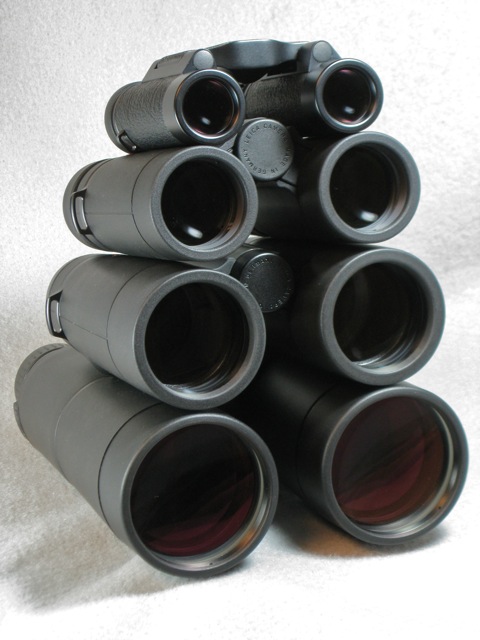 Aperture the second number of the binocular designation represents its aperture, the diameter of the front (objective) lens. The objective lenses gather light and form an image that is then magnified by the eyepieces.
Before the light reaches the eyepieces it passes through image erecting prisms so that the image will appear right side up and correct left to right. The diameter of this lens determines how much fine detail may be observed, particularly when the magnification is higher and therefore attempting to enlarge the basic image created by the objective lenses.
Aperture the second number of the binocular designation represents its aperture, the diameter of the front (objective) lens. The objective lenses gather light and form an image that is then magnified by the eyepieces.
Before the light reaches the eyepieces it passes through image erecting prisms so that the image will appear right side up and correct left to right. The diameter of this lens determines how much fine detail may be observed, particularly when the magnification is higher and therefore attempting to enlarge the basic image created by the objective lenses.
Click on image to see enlarged view (76,736 bytes).
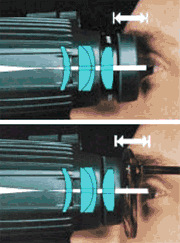 In the illustration to the right one can see how Leica's long eye relief (eyecup retracted) will accommodate a spectacle wearer. The rubber trim of the eyecup acts as a bumper cushion to protect the eyeglass lens. With the eyecup extended it provides shade preventing light that might otherwise come in from the sides from forming a distraction. With or without the eyecup extended, any user can brace the binocular against their brow or their spectacles for steadiness. While not common, there are some people who have deep set eyes, and wear very thick prescription glasses; this combination of factors may result in a need for so much eye relief that few if any binoculars will permit them to see the entire field of view.
The "C" in the suffix indicates the binocular is a compact model, suitable to be stored in a coat or shirt pocket.
The "A" suffix indicates the binocular has been treated with a non slip armoring of a durable synthetic material; this has now been replaced by an 'N' indicating armored with the improved near-focus range. Full size binoculars with the "L" suffix indicate a leather covering. The compact binoculars that are not armored are finished in black leather, while the BN series armored models are available in Green, Black, or for the Marine 7x 42 BN in Blue.
"DUOVID" describes the unprecedented Leica DUOVID 8 + 12 x 42 and Leica DUOVID 8 + 12 x 42 binoculars. The DUOVID is the first high performance binocular available worldwide capable of providing the user a choice of two magnifications (and with practice, a third too). Aside from the obvious benefits of being able to vary the magnifications, the DUOVID may solve the problem for couples or groups who must share one binocular, where one person may not be able to comfortably hand hold a binocular at magnifications higher than 10 x.
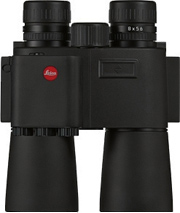
"GEOVID" is the term designating the laser range finding binoculars pioneered by Leica. These presently include the GEOVID 8x 42 BRF and 10x 42 BRF and
Left: original Leica Geovid 7x 42 BD range finding binocular displayed at Company Seven shown alongside an image of them cutaway (84,938 bytes).
When the first GEOVID 7x 42 BD binoculars arrived at Company Seven we were impressed by this unprecedented instrument. In part because of their Porro Prism arrangement these first 7x 42 BD series models were comparatively bulky (206mm wide x 178mm tall and 81mm deep) and heavy (about 1400 grams) so that we were not sure these would be carried about too casually by anyone. But in the early 1990's when a local scientist from the NASA Goddard Space Flight Center tested a GEOVID provided from Company Seven for applications measuring lava flows from volcanoes, he found it to be amazingly accurate at reading distances. That was when we were truly impressed at the utility and durability of the device as well as its precision.
Since the BDA were introduced these have been reduced in size while increasing their range and durability with the BRF and BRF HD series. The following GEOVID models are much more practical, employing roof prisms that make them comparable in size to conventional similar aperture binoculars. As each successive generation of GEOVID have been released they continue to be the most highly recommended range finding binocular by most experienced guides - the laser ranging standard since 1992.
In 2013 Leica announced yet another revolutionary advancement, the GEOVID HD-B series. These incorporate not only an even more accurate and longer distance capable laser ranging system, but also incorporate and inclinometer, barometer and thermometer. Accepting ballistics data for up to 12 pre-loaded ballistics curves corresponding to load caliber, type and weight, Leica's Advanced Ballistic Compensation (ABC) technology factors ambient conditions into the results shown to produce very accurate targeting. Their more streamlined Perger Porro prism optical train, owing to recently developed patented prisms designed at Leica, provide a lighter weight (945 grams) and more compact form yet with absolutely striking visual images.
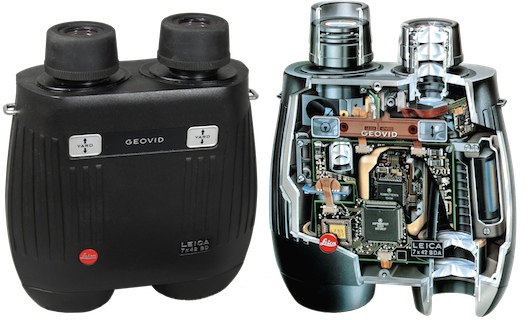 The original Leica GEOVID series of range finding binoculars were developed by a team led by Manfred Meinzer. The 7x 42 BD and 7x 42 BDA were introduced at Photokina in 1992; these was the first high performance binocular available capable of providing the user a display of distance (PN 40023 in meters, PN 40024 in yards) from the user to the target with a high degree of accuracy. The 7x 42 BDA (PN 40022) incorporated an added feature, the integral compass to provide readout of the bearings.
On the outside, the new BN binoculars can be differentiated from BA models only by the BN on their name plate, and by Leica product model numbers. While the ULTRAVID are clearly distinguished by their form as well as their respective BR and BL suffixes.
BN, BR, BL, HD SERIES At the famous "Photokina 2000" photographic industry trade show Leica announced the TRINOVID BN binocular series. And then in August 2003 continuing their tradition of innovation, Leica introduced their ULTRAVID series. For 2004 through 2007 Leica gradually upgraded their ULTRAVID binocular series to the ULTRAVID HD (retaining BL for leather covered models).
Increasingly, many nature lovers requested a pair of LEICA TRINOVID binoculars that would focus at shorter distances than the original BA series. And so Leica is catered to that demand with the TRINOVID BN and the most recently introduced ULTRAVID models. With the new TRINOVID BN and ULTRAVID models Leica provides ideal possibilities of getting really close to nature, as the TRINOVID BN binoculars featured two major innovations: a significantly improved close-focus range and Leica's HDC™ optical coating. While the lighter weight ULTRAVID series offer even better light throughput, further improvements in imaging properties, and improved ergonomics.
The Leica BN, BR, and ULTRAVID BL binoculars improved close-focus over the prior BA series of as close as 2.10 m (10x 32 BN), and not more than 3.60 m (8x 50 BN and 8x 50 BR) as close focus limits. The close-focus distance is of particular interest for field ornithology, insect watching, general nature observation and forestry. Leica's HTC™ optical coating employed on the exposed eyepiece and objective lenses is a multiple layer coating that is extremely resistant to abrasion and other environmental influences. This high resistance is achieved by a special process in which the coating materials are applied to the lens elements in a high-vacuum plasma technique.
The TRINOVID BN binoculars inherited the well-proven features of the previous TRINOVID BA models, such as the trend setting Leica Design, the high-quality optics with the successful Leica multiple coating, the Schmidt-Pechan pentaprisms and the true internal focusing, water tightness to a depth of 5 m, the patented multifunctional central drive, the high-point eyepieces with sliding eyecups and the polyurethane armoring. The ULTRAVID improves further in many of these areas.
Fluoride lenses: with the help of recently developed fluoride (FL) glass the Leica HD and APO spotting telescope models offer supreme color fidelity and contrast. Optical FL lenses are to a large part made up of calcium fluoride, a mineral with a crystalline structure. Unlike conventional optical lenses, this creates a very low level of dispersion (light scattering) and corrects aberration (imaging errors) significantly better than previous glasses. So as a result the viewing experience is more natural and three-dimensional, more impressive than it has ever been before
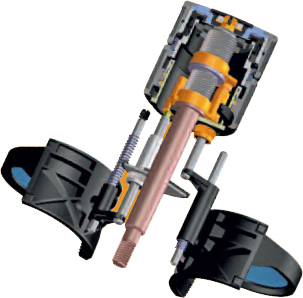 Leica Binocular Center Focus Mechanisms these are engineered to provide ease of use (central focus), quick and smooth performance, and a lifetime of reliable service. The focus mechanism is an "internal" arrangement where optics within the binocular body are moved to accomplish changes of focus. So the exterior does not change, the length of the binocular does not change with focus. This internal central focus mechanism makes it a quick and simple matter to change focus from very close objects out to infinity. And by means of this advanced mechanical arrangement the binocular is sealed well from moisture, dirt and other contaminants.
Left: Ultravid HD internal focusing mechanism. Rotating the focus collar drives a focusing lens element in each optical barrel (34,591 bytes).
Click on image to see enlarged view (65,030 bytes).
And focusing the Ultravid HD is even smoother than ever before. The mechanism remains free of play across the entire range. Optimized material pairings and gliding discs made from extremely tough, high-performance plastic are used. In cold conditions, the conventional greased focusing mechanisms sometimes only work with difficulty, and at higher temperatures they move too freely. Furthermore, these focusing mechanisms can feel "sticky", and at higher temperatures there is even the danger that grease can off gas or escape and run on the lens. With the optimized Leica focus, these risks have been eliminated. The new mechanics of the Ultravid HD models work practically without any lubricants. So even in extreme temperatures it is always fully functional and with a constantly optimal degree of smoothness.
Being mechanical systems, they may require only minor cleaning and/or lubrication service after years or decades of service - depending on the amount of use and the operating environment!
Diopter Adjustment As people age it is likely their vision will change in focus near or distant or both for example, and one may develop astigmatism too. Changes of the eye tend to result in various degrees of myopia (nearsightedness) or hyperopia (farsightedness). In a single tube such as a telescope we simply focus to accommodate differences between observers. But with binoculars it is necessary not only to focus to accommodate differences between people, but to also have some mechanism to compensate for differences between the left and right eyes.
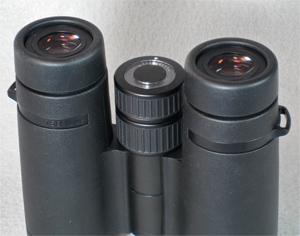 Leica binoculars incorporate mechanisms to compensate for differences between the left and right eyes known as a "diopter adjustment". The exact mechanical arrangement varies but the principle of operation remains the same to allow the observer to incorporate a consistent variable into the focusing. In the mid to larger Leica binoculars one simply:
2. gently pull the focus knob up (away from the binocular bridge)
3. now turn the protruding dial clockwise or counterclockwise to achieve best focus for the right eye
4. without turning the extended dial, turn the inner dial (adjacent the binocular bridge) clockwise or counterclockwise to achieve best focus for the right eye
5. without turning either dial, gently push the extended knob back into place to reseal the focus mechanism.
It is also possible that over time, some of the detrimental aspects may change in a way that improves vision too.
ULTRAVID HD series introduced in 2007 incorporates internal and coatings improvements. The exteriors were unchanged and the basic specifications (magnification, field of view, etc.) similarly remained the same so these appear at first glance identical to the original ULTRAVID models. The improvements provided with the HD address the focusing mechanism. And the optical design of the HD were refined with newly available Fluoride glass technology, and then were treated with advanced contrast and resistance coatings to repel water and dirt with the new AquaDuraTM process.
Leica AquaDuraTM ensures greater visibility in wind and rain
 It is a cold morning and the lens fogs up - that is not much fun. Fingerprints, dust and rain are also annoying when viewing. The innovative Leica AquaDuraTM coating considerably reduces these disturbing factors. Imitating nature as with the lotus plant, this new water and dirt-resistant protective layer on the outer glass surfaces ensures that dirt and moisture are barely able to take hold on the specially adapted surface structure of the optic. This is the same coating applied by Leica for their latest APO-TELEVID spotting telescopes introduced in 2007 and coming available in 2009.
Right: Microscopic image of water droplet demonstrating the operating principle of AquaDura (32,870 bytes).
Click on image to see enlarged view (47,295 bytes).
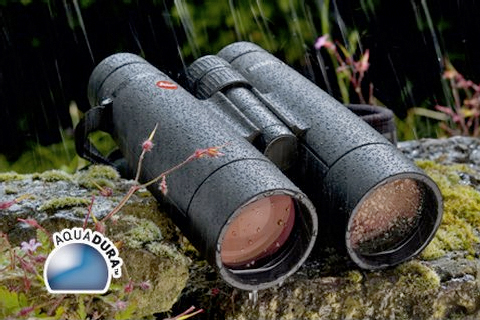 On the previous generations of anti-reflection coating the water tended to bead on the optical surface, this is particularly distracting on the eyepiece lenses being closer to focus. But with Leica AquaDuraTM the water droplets do not adhere, and the surface is also resistant to the formation of fog that would otherwise reduce contrast if not completely obscure the object of the observation.
Left: Leica AquaDura applied on the right objective lens of a Leica binocular. Compare this with previous generation high transmission coatings applied on the left objective (82,183 bytes).
Click on image to see enlarged view (142,864 bytes).
reduced cleaning efforts required leaves you more time for viewing!
n.b.: The coating has already been used for other binoculars, but is being advertised for the first time with the launch of the BN binoculars. The BC binoculars also feature HDC™ optical coating.
And in an interesting courtesy for our customers worldwide Leica binoculars are supplied with a new instruction manual translated into six languages: German, English, French, Dutch, Italian and Spanish.
Compare the TRINOVID BN and ULTRAVID BR/BL/HD models against the prior TRINOVID BA models:
| Binocular Model
Near Focus in Meters/Feet Before (BA series) Now (BR/BL/HD & BN series) |
||
|---|---|---|
| 8x32 | 3.25 m / 10.6 ft. | 2.30 m / 7.5 ft. |
| 10x32 | 2.70 m / 8.8 ft. | 2.10 m / 6.8 ft. |
| 7x42 | 6.30 m / 20.5 ft. | 3.30 m / 11 ft. |
| 8x42 | 5.30 m / 17.2 ft. | 3.10 m / 10.1 ft. |
| 10x42 | 4.60 m / 15 ft. | 2.95 m / 9.6 ft. |
| 8x50 | 5.40 m / 17.5 ft. | 3.60 m / 11.7 ft. |
| 10x50 | 4.80 m / 15.6 ft. | 3.30 m / 11 ft. |
| 12x50 | 4.60 m / 15 ft. | 3.20 m / 10.4 ft. |
Brief Description of Each Leica Binocular
Each factor outlined above about choosing a binocular may be as important a consideration as the other in assuring the long term satisfaction of our customer. However, in an effort to aid you with your search for the binocular of your dreams we have prepared the following brief:
The 8x 42 HD is available in armored Slate Black cladding while the 8x 42 ULTRAVID BL is provided with black leather covering for lighter weight, providing incidentally - a most luxurious appearance. And this version includes a beautiful and well engineered form fitting leather case. The 8x 42 ULTRAVID BL is the best of the most excellent of gifts. And it too is built to provide a lifetime of pleasure.
Its' wide angle eyepiece design (55 degrees at 8x and 61 degrees at 12x) also affords good eye relief for spectacle or sunglass wearers!
Using infrared light waves in a custom band from 300nm to 2000nm, the LightSpeed technology transmits voices (at 16, 32, or 64 Kbps) to another GEOVID LUX up to a distance of 1-½ miles (2-½ km) away - crystal-clear, without any interference, day and night. For voice it employs any tactical/COTS headset. Even data such as video, text or images can be fed in via the USB port and transmitted at a rate of up to 1 Mbps. This development has evolved from a cooperation arrangement with the well-known secure electronics development company in the USA. This form of bug-proof communication offers special police and military units a wealth of tactical advantages. The extremely compact yet powerful LEICA GEOVID LUX 8x 56 also has further application potential in stalking, industry and rescue services. US federal government agencies should contact Company Seven to obtain our DLA or ORCA information.
Additional On line Publications
To read more about the ULTRAVID HD series download:
 "Leica Innovations: ULTRAVID HD Binoculars & New TELEVID Spotting Telescopes". Two page color illustrated pamphlet describing our Leica new series ULTRAVID HD binoculars and APO-TELEVID spotting telescopes announced in August 2007. Focus is on the new FL Fluoride optics, the improved focus mechanism of the ULTRAVID HD, the Leica AquaDuraTM "hydrophobic" coatings technology. Publication content by Leica, all rights reserved. From Company Seven's Archives. 432,342 bytes (in Acrobat Reader ".pdf" format).
"Leica Nature Observation 2007: Binoculars, Rangefinders and Spotting Scopes". Complete 102 page, stunningly color illustrated brochure describing our Leica sport optics products including the ULTRAVID HD binoculars and APO-TELEVID spotting telescopes announced in August 2007. Publication content by Leica, all rights reserved. From Company Seven's Archives. 6,734,031 bytes (in Acrobat Reader ".pdf" format).
Return to our Leica products index page